Here are the images for my magazine cover, contents page, and double page spread.



Here is my critical self reflection for the magazine project.
The link to my critical self reflection in case the embed doesn’t work: https://www.canva.com/design/DAF7Vj0bKwI/Zz5-XwOSjeMNC7XZMaGxhw/edit
This is the development and research post for my magazine double page spread.


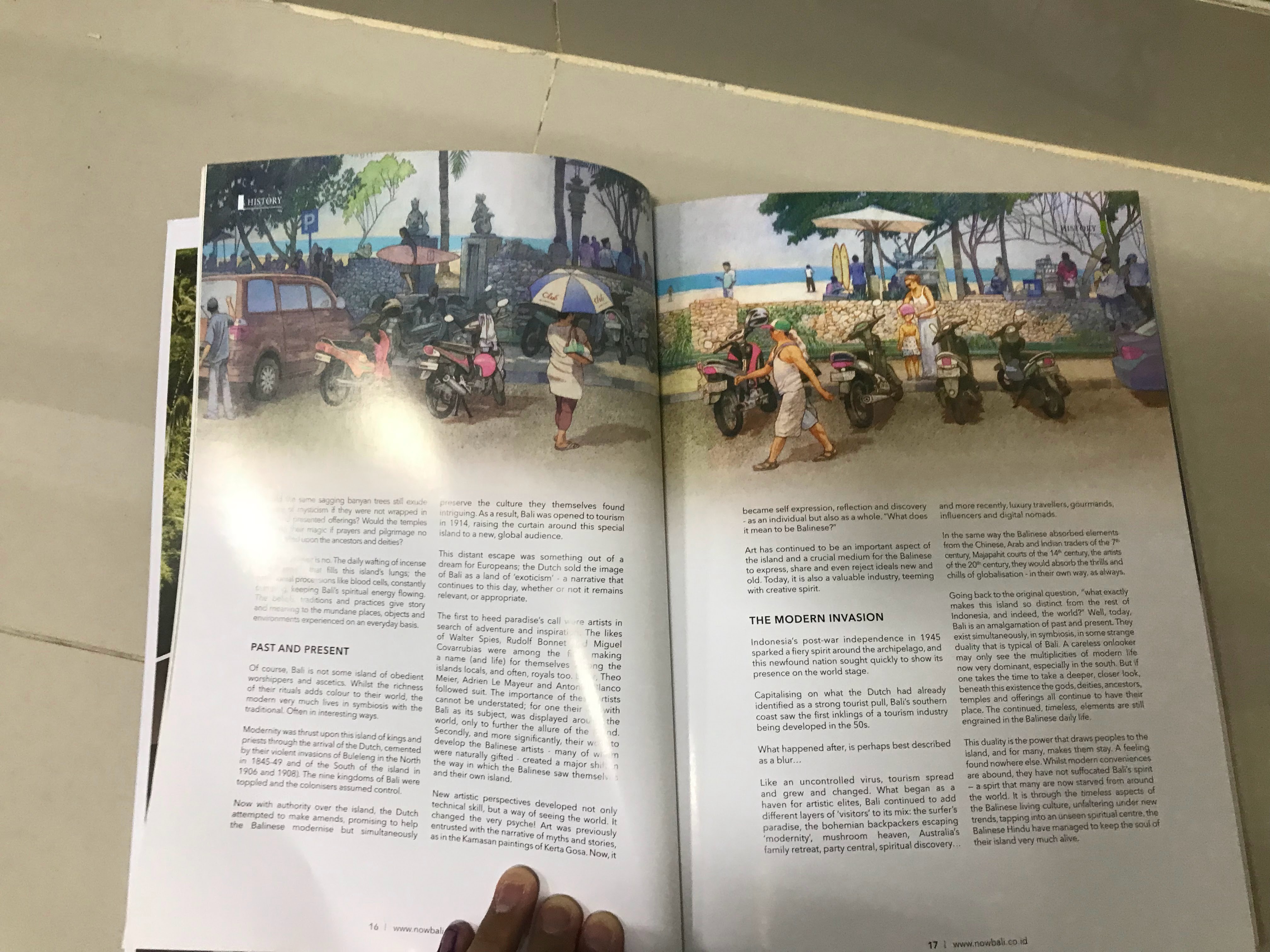


Here is my Magazine Contents Research and Development


Here is where I will be updating the research, the progress in the making of my magazine's front cover.


In this post, I will demonstrate some basic design skills that I learned in class.
1. I started by Sketching my magazine covers. I am not really satisfied with my drawing as I am not skilled enough to make a sophisticated result on it.

2. Then my teacher told me to experiment with some default magazine layouts.


3. Next, my teacher shows us elements on
- Borders
- Hierarchy of type (Times New Roman, Comic Sans)
- Typeface
- Colours
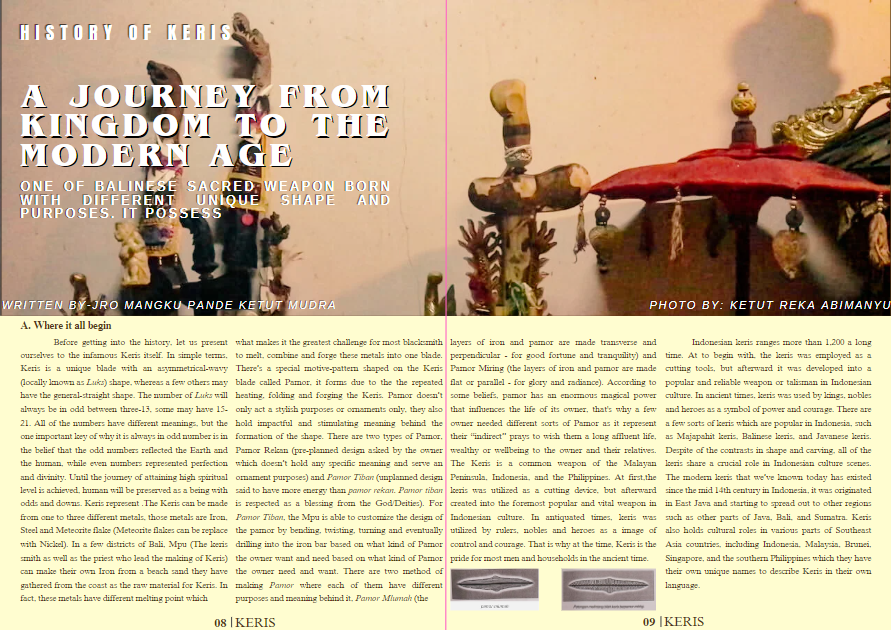
Here's my 1st draft magazine article
REFLECTION: Overall, I can imagine and visualise the flow of my article, I have some understanding and knowledge to what topic I will be outline, cover and discuss on my article. The purpose for my article is to counter common misconceptions (such as types of keris, the craftsmen, or the sacred journey to own a religious Keris) that has been established for a long time due to bias-judgement or misleading sources. Not only that, I would also cover a history of Keris in general to raise my reader's curiosity and create a more diverse content. I will be experimenting my articles in my free time after my exam so I am expecting some changes on this post later on (maybe I would add a reflection under the new changes or whatever to expand my skills and to outline the inspiration I can use).
A. Where it all begin
Indonesian keris ranges more than 1,200 a long time. At to begin with, the keris was employed as a cutting tools, but afterward it was developed into a popular and reliable weapon or talisman in Indonesian culture. In ancient times, keris was used by kings, nobles and heroes as a symbol of power and courage. There are a few sorts of keris which are popular in Indonesia, such as Majapahit keris, Balinese keris, and Javanese keris. Despite of the contrasts in shape and carving, all of the keris share a crucial role in Indonesian culture scenes. The modern keris that we’ve known today has existed since the mid 14th century in Indonesia, it was originated in East Java and starting to spread out to other regions such as other parts of Java, Bali, and Sumatra. Keris also holds cultural roles in various parts of Southeast Asia countries, including Indonesia, Malaysia, Brunei, Singapore, and the southern Philippines which they have their own unique names to describe Keris in their own language.
B. What is Keris?
Before getting know the history, let us introduce ourselves to the infamous Keris itself. In simple terms, Keris is a dagger or a blade with an asymmetrical-wavy shape (while some others may have the general-straight shape). The Keris can be made from one to three different metals, those metals are Iron, Steel and Meteorite flakes (meteorite flakes can be replaced with Nickel). In some regions of Bali, Mpu (The keris smith as well as the priest who lead the foraging of Keris) can make their own iron from the sea sand they have gathered from the coast as a raw material for Keris. In fact, these metal have different melting points which is what makes it the biggest challenge for most forager to melt, merge and forge these metals into one blade.
C. Pamor
There’s a unique motive-pattern formed on the Keris blade called Pamor, it forms due to the repeated heating, folding and forging the Keris. Pamor doesn’t only act as an aesthetic purposes, they also hold impactful and stimulating meanings behind the formation. There are two types of Pamor, Pamor Rekan (pre-planned pattern requested by the owner which doesn’t hold deep meaning and serve only as ornament purposes) and Pamor Tiban (unplanned pattern said to have more energy than pamor rekan. Pamor tiban is regarded as a gift from the God/Deities). For Pamor Tiban, the Mpu is able to customize the pattern of the pamor by twisting, bending, turning and eventually drilling into the iron bar based on what kind of Pamor the owner want and need. There are two methods of making Pamor where each of them have different intentions and meaning behind it, Pamor Mlumah (the layers of iron and pamor are made transverse and perpendicular - for luck and tranquility) and Pamor Miring (the layers of iron and pamor are made flat or parallel - for glory). According to some beliefs, pamor has an enormous magical power and influences to the life of its owner, that is why some owner wanted different types of Pamor as their “indirect” prays to wish them a long prosperous life, wealth or health to the owner and their relatives.
D. Keris in the SouthEastern Asian
The Keris is a common weapon along the Malayan Peninsula, Indonesia, and he Philippines. At first,the keris was used as a cutting tool, but later developed into the most famous and important weapon in Indonesian culture. In ancient times, keris was used by kings, nobles and heroes as a symbol of power and courage.
In this blog post, I will be putting the photos I've gathered in a 3 different location for a month of school Semestral Break as well as the Risk Assessment of all the places.

NAME | |
Purpose of the shoot: | Put the shoots of all the photos as the main cover, double page spreadsheet, or as one of the content of my magazine. |
Media Language: | Will consist of mostly medium shot photos to show the |
Pros of Location: | |
Cons of Location | |
Alternative location: | (reason) |
RISK ASSESSMENT | |
Potential Hazards | |
Evaluate Risks | |
Control Measures | |
Implementation Timeframe | |
